Detailed Indian Calendar
India is a land of 5000 year old civilization, with many different cultures, customs, spirituality, philosophy, people and languages. It is the land of celebrations. Fairs and festivals are the cultural heritage and spirit of Indian society to this day. India has seven major faiths. It has a large agricultural population and a rich historical background. All these Indian fairs and festivals represent people from diverse background, regions, communities and religions. The festivities are marked by folk dances, music played on a variety of local instruments, and traditional food. All festivals have their own spectacle, with important characteristics. There are religious festivals, cattle fairs and seasonal festivals celebrations throughout the year. Indian festivals encompass processions in the streets, decoration of homes and sacred places such as temples, folk song and dance performances. Most religious festivals have elaborate prayers, traditions, customs and rituals attached to them.
Indian festivals don’t have fixed dates because they don’t follow the Gregorian calendar.
The Indian Calendar system and the Gregorian calendar system
The western calendar is known as Gregorian calendar. It is based on the sun, in which, one year is the time required for the earth to complete one round around the sun. Earth takes 365 days, 5 hours, 48minutes and 46seconds to complete a rotation around the sun. In our one year we have 365days, but these extra hours, minutes and seconds every year, create an extra day every four years. The year with an extra day is known as leap year.
The Hindu calendar was founded in the Vedic times, and it has gone through number of changes through the ages. It is known as Panchang, which is based on both the sun and the moon. This calendar covers everything from phases of the moon, the positions of stars and planets, and identifies auspicious times and days, for various activities. It uses a solar year but divides it into 12 lunar months. A lunar month is precisely 29 days, 12 hours, 44 minutes, and 3 seconds long. Twelve such months constitute a lunar year of 354 days, 8 hours, 48 minutes, and 36 seconds. To match the lunar months with the year, every two and a half year an extra months arises. In other words, every 30 months an extra month is added. This extra month is known as Adhik Mas. In the Indian calendar, seasons follow the sun, months follow the moon, and days follow both sun and moon. Lunar days in the Indian calendar are called Tithis. The Tithi system works from full moon night, to new moon night, to full moon night. Indian festivals follow the Tithis calander, this is why festivals in India don’t follow the Gregorian calendar dates. The Indian government and businesses use the Gregorian calendar for administrative purposes.

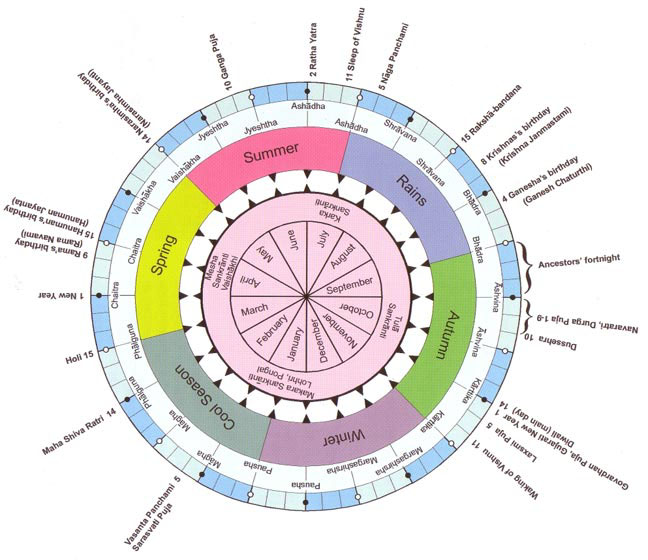
The above image shows the months of the Lunar calendar. The first month of the year is Chaitra, which starts around the end of March or beginning of April, depending on the Tithi calculation. The following months continue through the rest of the year.